2016-07-22
THE CON GAME: Explaining the Existence of Con-Artists
Publication
Publication
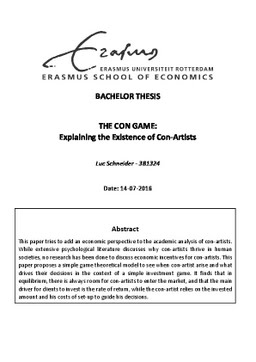
This paper tries to add an economic perspective to the academic analysis of con-artists. While extensive psychological literature discusses why con-artists thrive in human societies, no research has been done to discuss economic incentives for con-artists. This paper proposes a simple game theoretical model to see when con-artist arise and what drives their decisions in the context of a simple investment game. It finds that in equilibrium, there is always room for con-artists to enter the market, and that the main driver for clients to invest is the rate of return, while the con-artist relies on the invested amount and his costs of set-up to guide his decisions.
| Additional Metadata | |
|---|---|
| Kamphorst, J. | |
| hdl.handle.net/2105/34270 | |
| Business Economics | |
| Organisation | Erasmus School of Economics |
|
Schneider , Luc -. (2016). THE CON GAME:
Explaining the Existence of Con-Artists. In Business Economics.http://hdl.handle.net/2105/34270 |
|