2016-08-09
Sources of Uncertainty
Publication
Publication
How do Knowledge and Epistemic or Aleatory Uncertainty affect Ambiguity Attitudes
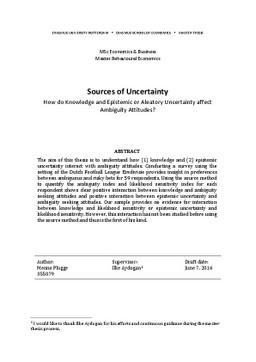
The aim of this thesis is to understand how (1) knowledge and (2) epistemic uncertainty interact with ambiguity attitudes. Conducting a survey using the setting of the Dutch Football League Eredivisie provides insight in preferences between ambiguous and risky bets for 59 respondents. Using the source method to quantify the ambiguity index and likelihood sensitivity index for each respondent shows clear positive interaction between knowledge and ambiguity seeking attitudes and positive interaction between epistemic uncertainty and ambiguity seeking attitudes. Our sample provides no evidence for interaction between knowledge and likelihood sensitivity or epistemic uncertainty and likelihood sensitivity. However, this interaction has not been studied before using the source method and thus is the first of his kind.
| Additional Metadata | |
|---|---|
| Aydogan, I. | |
| hdl.handle.net/2105/34459 | |
| Business Economics | |
| Organisation | Erasmus School of Economics |
|
Plugge, M. (2016, August 9). Sources
of
Uncertainty: How
do
Knowledge
and
Epistemic
or
Aleatory
Uncertainty
affect
Ambiguity
Attitudes. Business Economics. Retrieved from http://hdl.handle.net/2105/34459 |
|