2023-06-25
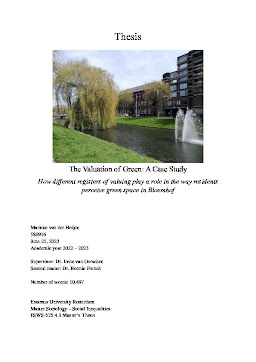
The Valuation of Green: A Case Study How different registers of valuing play a role in the way residents perceive green space in Bloemhof
Publication
Publication
Abstract Green spaces serve as crucial climate adaptive measures and raise concerns regarding environmental injustice issues due to the unequal distribution and accessibility within urban areas. Rotterdam exemplifies this issue, with certain districts, like Bloemhof, experiencing limited access to green spaces. To shed light on how residents perceive and value these limited green spaces, valuation studies are employed. Drawing on qualitative studies, this study gathers data through interviews and observations. By incorporating social justice theories and employing a transformative framework, this research aims to give voice to underprivileged people in Bloemhof, promote positive change, and advocate for the provision of adequate green spaces for all residents. By doing so, different registers of valuing are discovered that represent a lens through which the residents assign significance to green space. The following registers of value are of particular interest in the case of Bloemhof: 1) biographical time, 2) the importance of naturalness, 3) emotional and psychological benefits, and 4) recreational and social value. This study concludes that these registers offer unique information for green, as well as valuation studies, by creating insights to improve the availability of green spaces in underprivileged areas, while also promoting a more sustainable, equal, urban environment.
| Additional Metadata | |
|---|---|
| Van Oorschot, I., French, B.E. | |
| hdl.handle.net/2105/70738 | |
| Sociology | |
| Organisation | Erasmus School of Social and Behavioural Sciences |
|
Van der Heijde, M.S. (2023, June 25). The Valuation of Green: A Case Study
How different registers of valuing play a role in the way residents perceive green space in Bloemhof. Sociology. Retrieved from http://hdl.handle.net/2105/70738 |
|