2023-08-05
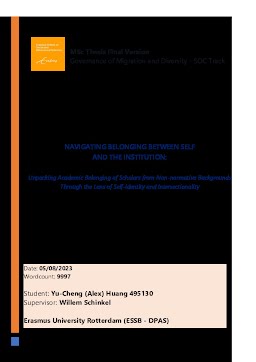
NAVIGATING BELONGING BETWEEN SELF AND THE INSTITUTION: Unpacking Academic Belonging of Scholars from Non-normative Backgrounds Through the Lens of Self-identity and Intersectionality
Publication
Publication
The thesis investigated how scholars from non-normative backgrounds navigate belonging in Dutch HEIs. Despite D&I being commonly utilized, belonging could be a more meaningful approach to understanding and fostering marginalized scholars' academic careers. I applied the qualitative personal narrative methodology and approached scholars' identity through the intersectional and self-identity lens, which captured a diverse set of identity expressions that explained how identities relating to privileges or disadvantages could manifest dynamic experiences with belonging. Respondents' narrative highlighted Dutch HEIs' competitive, hierarchical, and male-dominated culture that makes belonging challenging. Besides, the analysis showed that while junior scholars expressed struggles to belong, senior and former scholars refer to belonging to self instead of HEI. Meanwhile, scholars with multiple disadvantaged self-identities face more career barriers and priorities survival over belonging. Scholars also pointed out that the current D&I approaches can be non-relevant or foster more competition. Nonetheless, the various ways of change-making related to self-identities are vital for navigating belonging and feeling hope. The thesis concluded that belonging for scholars from non-normative backgrounds is complex as a stereotypical path exists for the typical type of scholar. However, participants' narrative indicates that belonging can be navigated in ways meaningful to selves, at a slower pace, and beyond HEIs, such as in the academic field. Finally, the intersectional lens highlighted that marginalization in HEIs could be intersectional. Hence, to make structural and meaningful changes, HEIs ought to move beyond D&I policies built around singular and binary identity categories.
| Additional Metadata | |
|---|---|
| Schinkel, W., French, B.E. | |
| hdl.handle.net/2105/70779 | |
| Sociology | |
| Organisation | Erasmus School of Social and Behavioural Sciences |
|
Huang, Y. (2023, August 5). NAVIGATING BELONGING BETWEEN SELF AND THE INSTITUTION: Unpacking Academic Belonging of Scholars from Non-normative Backgrounds Through the Lens of Self-identity and Intersectionality. Sociology. Retrieved from http://hdl.handle.net/2105/70779 |
|