2023-06-23
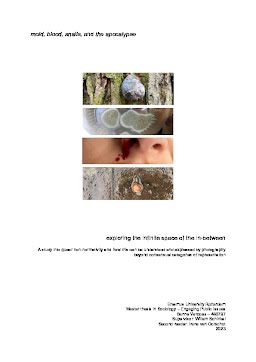
mold, blood, snails, and the apocalypse exploring the infinite space of the in-between A study into queer non-normativity and how this can be understood and expressed by photography beyond consensual categories of representation
Publication
Publication
This thesis uses the creative method photo-story to answer how queer non-normativity can be understood and expressed by photography beyond consensual categories of representation (Campany & Wolukau-Wanambwa, 2022). It is a report of lived experiences of gender-queer people that challenge norms. Gender-queer people refuse to order themselves and thereby explore a space outside of categorization, already imagining how ways of living together could be different (Halberstam, 2020). The open and reflexive method photo-story is used to explore the queer relation to order, by letting gender-queer people represent their world. The base of the understanding of queer non-normativity is to embrace its ambivalence. By using the four concepts refusal, failure, happiness, and futurity, it becomes clear they do not have one strict example, meaning, or representation, since gender-queer people push the definitions, rethinking norms, and values, as a way to navigate through mainstream normativity. They transform and engage in actively altering the human as image and stereotypical representations, by disidentification.
| Additional Metadata | |
|---|---|
| Schinkel, W., Van Oorschot, I. | |
| hdl.handle.net/2105/70783 | |
| Sociology | |
| Organisation | Erasmus School of Social and Behavioural Sciences |
|
Verdoes, S. (2023, June 23). mold, blood, snails, and the apocalypse
exploring the infinite space of the in-between
A study into queer non-normativity and how this can be understood and expressed by photography beyond consensual categories of representation. Sociology. Retrieved from http://hdl.handle.net/2105/70783 |
|