2022-07-28
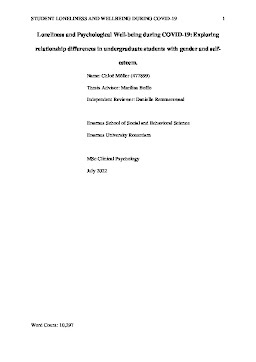
Loneliness and Psychological Well-being during COVID-19: Exploring relationship differences in undergraduate students with gender and self-esteem.
Publication
Publication
This paper presents the first-wave results of a four-part longitudinal study using the Student Wellbeing Monitor during and post-COVID-19 examining the relationship between loneliness and wellbeing in university students during the pandemic and exploring moderating effects of self-esteem and gender. Using a cross-sectional, correlational design, the sample consisted of 1045 bachelor students in their first and final year, between the ages of 16 to 68 (M=20.55,SD=3.79), and representing 85 different nationalities. During the period of December 2020, to February 2021, participants completed a survey that included the Warwick-Edinburgh Mental Wellbeing Scale (WEMWBS), Gierveld Loneliness Scale - Short Form (GLS-SF) and Self-Esteem Rating Scale – Short Form (SERS-S). Results showed the student mean scores were below average on wellbeing and self-esteem scales compared to normative samples from the original articles and had moderate levels of total loneliness. Males presented with higher levels of self-esteem than females. Loneliness and wellbeing showed a significant negative relationship independently of gender. Self-esteem was a significant moderator in the relationship between loneliness and wellbeing. However, post-hoc analysis revealed the intensity of one’s self-esteem did not affect the relationship. Implications highlight the importance of valuable social contact and encouraged interventions at the individual and institutional levels to improve student mental health. Limitations and future research are explored.
| Additional Metadata | |
|---|---|
| Boffo, M., Remmerswaal, D. | |
| hdl.handle.net/2105/70918 | |
| Psychology | |
| Organisation | Erasmus School of Social and Behavioural Sciences |
|
Möller, C.A.R. (2022, July 28). Loneliness and Psychological Well-being during COVID-19: Exploring relationship differences in undergraduate students with gender and self-esteem.. Psychology. Retrieved from http://hdl.handle.net/2105/70918 |
|