2024-06-22
Behind the Boycott: Understanding why Dutch consumers boycott Israeli goods
Publication
Publication
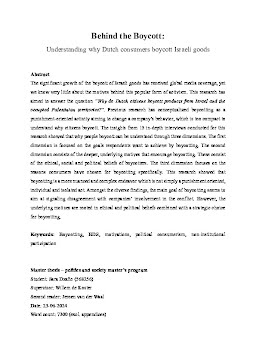
The significant growth of the boycott of Israeli goods has received global media coverage, yet we know very little about the motives behind this popular form of activism. This research has aimed to answer the question “Why do Dutch citizens boycott products from Israel and the occupied Palestinian territories?”. Previous research has conceptualized boycotting as a punishment-oriented activity aiming to change a company’s behavior, which is too compact to understand why citizens boycott. The insights from 15 in-depth interviews conducted for this research showed that why people boycott can be understood through three dimensions. The first dimension is focused on the goals respondents want to achieve by boycotting. The second dimension consists of the deeper, underlying motives that encourage boycotting. These consist of the ethical, social and political beliefs of boycotters. The third dimension focuses on the reasons consumers have chosen for boycotting specifically. This research showed that boycotting is a more nuanced and complex endeavor which is not simply a punishment oriented, individual and isolated act. Amongst the diverse findings, the main goal of boycotting seems to aim at signaling disagreement with companies’ involvement in the conflict. However, the underlying motives are rooted in ethical and political beliefs combined with a strategic choice for boycotting.
| Additional Metadata | |
|---|---|
| De Koster, W., Van der Waal, J. | |
| hdl.handle.net/2105/75537 | |
| Sociology | |
| Organisation | Erasmus School of Social and Behavioural Sciences |
|
Džafić, S. (2024, June 22). Behind the Boycott: Understanding why Dutch consumers boycott Israeli goods. Sociology. Retrieved from http://hdl.handle.net/2105/75537 |
|