2024-12-20
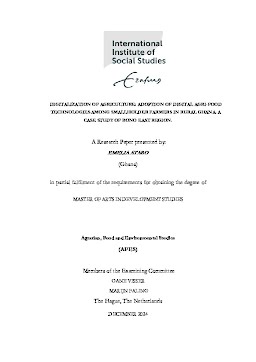
Digitalization of agriculture: adoption of digital agri-food technologies among smallholder farmers in rural Ghana
Publication
Publication
A case study of Bono East region
Adoption of digital technologies among smallholder farmers is believed to be the “game changer” for agricultural transformation in sub-Sahara Africa, including Ghana, due to their abilities to provide farmers with insights that help them optimize their production, access appropriate services and products and explore new market linkages. However, the framing of the adoption of these digital technologies among smallholder farmers is often oversimplified into binary metrics (adoption and non-adoption). This kind of approach often reduces adoption to a technical process of increasing uptake, ignoring the complex realities of farmers’ lives and the different capacities to engage these tools, as well as the group dimensions of adoption. This study examines how the adoption of digital technologies takes place and the impact on farming practices among smallholder farmers in Bono East region of Ghana. Employing both qualitative and quantitative methods in obtaining data, the study revealed that subscriptions among smallholder farmers are high in the study area, but that active engagement with these platforms is much less than high subscriptions would suggest at first glance. The study also identified factors that influence the adoption and use of these platforms including individual, institutional, and innovation. Lastly, the study revealed that the perceived impact of the adoption of digital technologies extends beyond mere improvements in farming practices, such as weather updates and agronomic advice (fertilizer application). It can exacerbate inequalities, dependency, and deskilling of farmers.
| Additional Metadata | |
|---|---|
| , , , | |
| Visser, Oane | |
| hdl.handle.net/2105/75661 | |
| Agrarian, Food and Environmental Studies (AFES) | |
| Organisation | International Institute of Social Studies |
|
Atabo, Emelia. (2024, December 20). Digitalization of agriculture: adoption of digital agri-food technologies among smallholder farmers in rural Ghana: A case study of Bono East region. Agrarian, Food and Environmental Studies (AFES). Retrieved from http://hdl.handle.net/2105/75661 |
|