2024-12-20
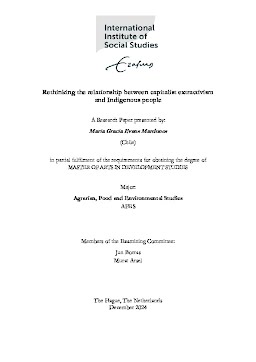
Rethinking the relationship between capitalist extractivism and Indigenous people
Publication
Publication
In critical environmental studies, Indigenous peoples are often portrayed as stewards of the land and nature, inherently opposing large-scale capitalist extractivist operations on their territories and mobilizing for the defense of their lands and natural environments. However, how can this dominant perspective account for when Indigenous peoples mobilize to get incorporated into extractivist capitalist corporate operations in their land? To explore this literature gap, I examine the Lleulleu project, a collaborative forestry initiative involving thirteen Mapuche communities and the forestry company CMPC in Chile. I demonstrate that through this incorporation, the boundaries between capitalist extractivism and Indigeneity become blurred. By analyzing the reasons why Indigenous people pursue partnerships with extractive companies, I examine how these projects intertwine historical land reclamations and Indigenous traditional social structures with the expansion of extractive capitalist activities on Indigenous lands. Indigenous peoples are incorporated as small capitalists, with initiatives that increase their wealth accumulation. In this context, resources act as means to obtain class recognition and access to their historical Indigenous claims regarding land and sovereignty. However, it is important to consider power imbalances in this new scenario, where Indigenous people are incorporated, but they are also highly dependent economically and socially on the extractive corporative industry.
| Additional Metadata | |
|---|---|
| , , , , , | |
| Borras, Jun | |
| hdl.handle.net/2105/75668 | |
| Agrarian, Food and Environmental Studies (AFES) | |
| Organisation | International Institute of Social Studies |
|
Evans Mardones, Maria Gracia. (2024, December 20). Rethinking the relationship between capitalist extractivism and Indigenous people. Agrarian, Food and Environmental Studies (AFES). Retrieved from http://hdl.handle.net/2105/75668 |
|