2024-12-20
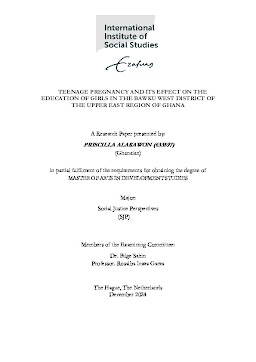
Teenage pregnancy and its effect on the education of girls in the Bawku West district of the Upper East Region of Ghana
Publication
Publication
While the Ghanaian government has made considerable efforts towards child education, teenage pregnancy remains one of the main factors hampering continued education for girls across various communities in the country. The main objective of this study was to examine the causes of teenage pregnancy and its effect on girls’ education in the Bawku West district in the Upper East Region of Ghana. A qualitative research methods were employed. Purposive and snowball sampling were used to recruit the study participants. A total of 13 participants were selected including 5 pregnant student girls, 3 teen mothers, 2 non-pregnant student girls, one opinion leader (an assembly man) one girl child officer and one teacher. The findings revealed that occurrence of teenage pregnancy among school girls in the Bawku West district is caused by various factors such as poverty, early marriage, poor parental guidance and support, inadequate information and knowledge about sexual issues, peer influence and unequal gender norms and cultural practices. Furthermore, it was observed that school dropout, poor school performance and limited personal development are major negative effects of teenage pregnancy on girls’ education. Therefore, the study suggested that sex education should be given due consideration within the school curriculum to enhance the knowledge and understanding of Ghanaian school children in the study area and the country as a whole about sexual and reproductive health issues.
| Additional Metadata | |
|---|---|
| , , , , | |
| Sahin, Bilge | |
| hdl.handle.net/2105/75703 | |
| Social Justice Perspectives (SJP) | |
| Organisation | International Institute of Social Studies |
|
Alakawon, Priscilla. (2024, December 20). Teenage pregnancy and its effect on the education of girls in the Bawku West district of the Upper East Region of Ghana. Social Justice Perspectives (SJP). Retrieved from http://hdl.handle.net/2105/75703 |
|