2024-12-20
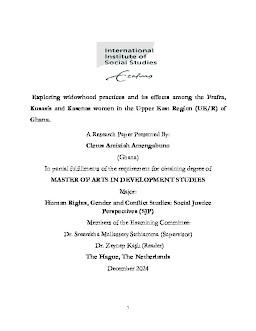
Exploring widowhood practices and its effects among the Frafra, Kusasis and Kasenas women in the Upper East Region (UE/R) of Ghana
Publication
Publication
This study explored widowhood practices on widowed women in the Upper East Region of Ghana. The paper examines what widowhood practices are, the context at which the widowhood practices are performed. The effects of the practices on the widowed women in relation to their experiences and opinions to the widowhood practices and how the practices violate widows’ rights as an aspect of concern of the research. The study followed a qualitative approach. Using intersectionality and gender power relation concepts, the research carried out semi-structured interviews with nine (9) widows and twelve (12) other stakeholders through snow balling and purposive sampling respectively. The data were collected through in-depth interviews and data gathered were analyzed using thematic analysis. The findings revealed that widowhood practices are culturally constructed practice that serves the interest of each ethnic group, and their meanings attached to them after the death of one’s husband. Strikingly, these practices include, shaving of the widow’s head, confinement of widow, holding of calabash, stripped naked, and sitting on the floor or mat. Inherently, these widowhood practices exposed the widowed women to various embarrassing and harmful experiences. Amidst the recommendations of this research, widowhood practices need social transformation, right from the local actors, institutional actions to the national level for widows to receives justice in the Upper East Region of Ghana.
| Additional Metadata | |
|---|---|
| , , , , , , , | |
| Mullassery Sathiamma, Sreerekha | |
| hdl.handle.net/2105/75704 | |
| Social Justice Perspectives (SJP) | |
| Organisation | International Institute of Social Studies |
|
Amiziah, Cletus Amengabuno. (2024, December 20). Exploring widowhood practices and its effects among the Frafra, Kusasis and Kasenas women in the Upper East Region (UE/R) of Ghana. Social Justice Perspectives (SJP). Retrieved from http://hdl.handle.net/2105/75704 |
|