2024-12-20
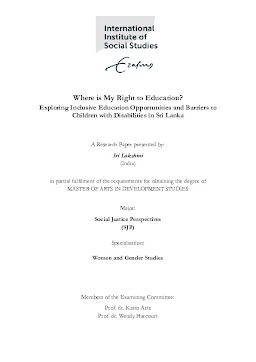
Where is my right to education? Exploring inclusive education opportunities and barriers to children with disabilities in Sri Lanka
Publication
Publication
Every child in Sri Lanka has the right to education. This position is underpinned by robust international and national frameworks. Despite these commitments, most children with disabilities in Sri Lanka are left behind with little to no education. Ampara district is set against the background of scenic landscapes abundant with nature, a history of progressive education reforms for mainstream education, and burdened by the aftereffects of colonial rule, a longstanding civil war, economic consequences of the COVID pandemic, and the ongoing economic crisis. This study in Ampara district explored the experiences of children with disabilities in accessing inclusive education, as well as the quality of education for those who make it to school. This has been accomplished by employing critical disability theory, a prominent approach in disability studies, to focus attention on the socio-economic-political opportunities and barriers for children with disabilities in the education landscape. Qualitative research was conducted with children with disabilities (girls and boys), their families, teachers and principals, and government officers, in three ethnic regions – Sinhala, Tamil and Muslim – in rural regions of Ampara. The experiences of these children with disabilities around different models of education (or no education at all) have been analysed to understand how these varied factors come to play in enhancing or impeding their education. The study actively included the voices of children and adults with disabilities as this research concerns their education and lives.
| Additional Metadata | |
|---|---|
| , , , , , , , , , | |
| Arts, Karin | |
| hdl.handle.net/2105/75722 | |
| Social Justice Perspectives (SJP) | |
| Organisation | International Institute of Social Studies |
|
Lakshmi, Sri. (2024, December 20). Where is my right to education? Exploring inclusive education opportunities and barriers to children with disabilities in Sri Lanka. Social Justice Perspectives (SJP). Retrieved from http://hdl.handle.net/2105/75722 |
|