2024-12-20
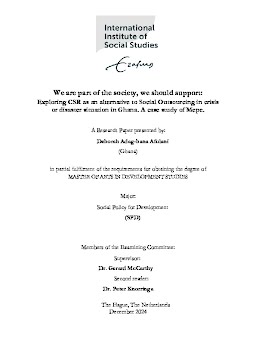
We are part of the society, we should support: Exploring CSR as an alternative to social outsourcing in crisis or disaster situation in Ghana
Publication
Publication
A case study of Mepe
Corporate Social Responsibility (CSR) is a common practice in Ghana, especially during religious and traditional festivities of the various ethnic groups. There has however been a growing number of organizations stepping up to support communities that experience dis-asters. Despite these trends, CSR activities are largely voluntary with no proper national CSR policies regulating them as noted by other researchers except the organizations’ own internal policies, mostly coined around the Sustainable Development Goals (SDGs). Several calls from academia and corporate Ghana, have articulated the policy gap and called for government action. This study seeks to contribute to the literature on CSR in the development of Ghana and especially focusing on how government can encourage and streamline CSR, leveraging it as social outsourcing in cases of crisis or disaster, using Mepe, a small town in Ghana as a case study. This study documents the role of organizations in filling service delivery gaps by providing subventions in a variety of sectors including education, health, water and sanitation, climate action and others that should ordinarily be provided by government. It also finds that collaborations exist between organizations, government and other stakeholders to support communities during disasters or crisis since organizations deem it appropriate to support the communities for the social license to operate (SLO). Crowdfunding has emerged as a financial avenue to support communities in crisis it results very visible in Mepe. And as organizations are doing their bit, government needs to put in place measures to encourage and stream-line their activities. One approach is for the organizations interested or involved in CSR to establish a coordinating body on their own or the government leads this action by forming an independent coordinating body that oversees CSR by first setting clear guidelines for organizations depending on their size, industry and roots (International organizations, Ghanaian organizations with government interest and private Ghanaian organizations) and also creating a database that actively accounts for support given and what more needs to be done to fill any gaps. This study falls short in its scope as it is limited to one locality in Ghana. There is therefore need for a wider study on different disaster situations either natural or man-made. A wider study on the practices of public and private organizations is also suggested to better under-stand their various policies and how to develop them into a cohesive national CSR agenda.
| Additional Metadata | |
|---|---|
| , , , , | |
| McCarthy, Gerard | |
| hdl.handle.net/2105/75739 | |
| Social Policy for Development (SPD) | |
| Organisation | International Institute of Social Studies |
|
Afulani, Deborah Adag-bana. (2024, December 20). We are part of the society, we should support: Exploring CSR as an alternative to social outsourcing in crisis or disaster situation in Ghana: A case study of Mepe. Social Policy for Development (SPD). Retrieved from http://hdl.handle.net/2105/75739 |
|