2024-12-20
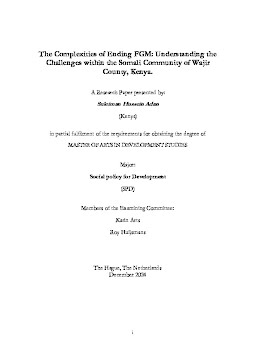
The complexities of ending FGM: Understanding the challenges within the Somali community of Wajir county, Kenya
Publication
Publication
Female Genital Mutilation (FGM) is a harmful cultural practice that violates women’s and children’s rights. FGM has serious negative implications for the health and wellbeing of girls and women and hampers their potential development. FGM continues to affect millions of girls and women, despite the various forms of efforts from governments, NGOs, and the private sector to end it. Among the many communities that practice FGM in Africa, the Somali community remains one that widely practices FGM for cultural and religious reasons. This research focuses on exploring why the practice of FGM persists within the Somali community of Wajir County, Kenya. The study adopts a child rights-based approach to examine how FGM violates rights that are enshrined in various children’s rights instruments. The study further examines the effectiveness of anti-FGM laws in tackling the continuation of FGM in Africa and the rest of the world. In this study, qualitative methods were employed to collect data through semi-structured interviews with representatives of government agencies and non-governmental organizations, and with religious leaders. The findings of this research suggest various reasons explaining the persistence of FGM among the Somali community in Wajir county, Kenya and ways of overcoming those challenges. More specifically, the research further examines the contributions of law in ending FGM within the Somali community.
| Additional Metadata | |
|---|---|
| , , , , , , | |
| Arts, Karin | |
| hdl.handle.net/2105/75740 | |
| Social Policy for Development (SPD) | |
| Organisation | International Institute of Social Studies |
|
Adan, Suleiman Hussein. (2024, December 20). The complexities of ending FGM: Understanding the challenges within the Somali community of Wajir county, Kenya. Social Policy for Development (SPD). Retrieved from http://hdl.handle.net/2105/75740 |
|