2024-12-20
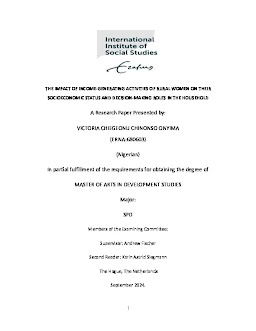
The impact of income-generating activities of rural women on their socioeconomic status and decision-making roles in the household
Publication
Publication
The focus of this research is on the income-generating activities of women living in rural areas of Nnewi and Onitsha Local Government Areas of Anambra State, Nigeria, and how these activities influence socioeconomic status and decision-making within the household. In this context of the discussions regarding empowerment and poverty reduction, this study also seeks to clarify the relationship of economic empowerment to poverty alleviation. 15 women were purposively sampled; 8 in Nnewi and 7 in Onitsha were interviewed using a structured questionnaire and the information was analyzed qualitatively and quantitatively. From the findings, the majority of the women are involved in agriculture, but women’s income levels in the trade and artisan sectors are higher. It also shows that women use their income to cater to families in which case in Nnewi women spend more including education and health than women in Onitsha. Almost 80% of the women indicate that because of their ability to generate income, their decision-making level in the family has risen. But family setup, education, access to land access to finance, and so forth, make the degree to which women are empowered differ. This research therefore elucidates that although engaging in economic activities has some empowering effect on women, this is however not sufficient to eradicate poverty among them. For sustainable change, empowerment should be integrated with education, enhancing access to financial resources and supporting the availability of development strategies that promote equal participation of men and women in decision-making.
| Additional Metadata | |
|---|---|
| , , , , , , , | |
| Fischer, Andrew | |
| hdl.handle.net/2105/75745 | |
| Social Policy for Development (SPD) | |
| Organisation | International Institute of Social Studies |
|
Chinonso Onyima, Victoria Chiegeonu. (2024, December 20). The impact of income-generating activities of rural women on their socioeconomic status and decision-making roles in the household. Social Policy for Development (SPD). Retrieved from http://hdl.handle.net/2105/75745 |
|