2024-12-20
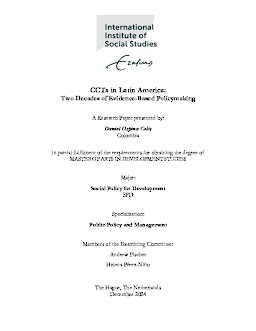
CCTs in Latin America: two decades of evidence-based policymaking
Publication
Publication
This research explores the politics around conditional cash transfer programs (CCTs) in Latin America. The main research question is: why have CCTs survived for over two decades in most Latin American countries? To solve this puzzle, this study focuses on the Colombian CCT program. It unveils the motives behind several modifications, adjustments, and evaluations made between 2000 and 2024 to the CCT scheme by resorting to policy documents and semi-structured interviews with former policymakers. In doing so, I argue that the adoption of evidence-based policymaking as the gold standard contributed to the survival of CCTs because it gave policymakers the chance to depoliticize social policy and justify the continuation of the program on its success as determined by the evidence. To produce such evidence, policymakers created a CCT program with very narrow objectives and interpreted the results of different program evaluations in a very specific way.
| Additional Metadata | |
|---|---|
| , , , , | |
| Fischer, Andrew | |
| hdl.handle.net/2105/75765 | |
| Social Policy for Development (SPD) | |
| Organisation | International Institute of Social Studies |
|
Ospina Celis, Daniel. (2024, December 20). CCTs in Latin America: two decades of evidence-based policymaking. Social Policy for Development (SPD). Retrieved from http://hdl.handle.net/2105/75765 |
|