2024-12-20
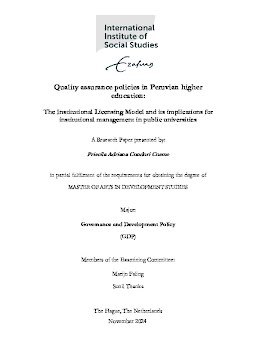
Quality assurance policies in Peruvian higher education: the Institutional Licensing Model and its implications for institutional management in public universities
Publication
Publication
This research explored the implications of Institutional Licensing, a mandatory quality assurance mechanism applied since 2016, in the understanding, commitments and practices of institutional management in Peruvian public universities, but also analyzed to what extent this mechanism helped to laid solid foundations for a better educational quality. By using a qualitative methodology focused on in-depth interviews with administrative staff from universities, this document aimed to contribute with the knowledge on the implications of quality assurance mechanisms. Findings revealed that although Licensing was initially perceived as a control mechanism, the implementation of it gradually propelled an identification with the value of quality in institutions, despite the limitations in its design and implementation. However, even with the progress in management practices oriented towards quality, there are still meaningful challenges for the sustainability of these changes, especially with limited resources and normative changes. This suggests the need for a quality assurance approach that converges with the diverse needs of the public higher education institutions.
| Additional Metadata | |
|---|---|
| , , , | |
| Faling, Marijn | |
| hdl.handle.net/2105/75779 | |
| Governance and Development Policy (GDP) | |
| Organisation | International Institute of Social Studies |
|
Condori Cosme, Priscila Adriana. (2024, December 20). Quality assurance policies in Peruvian higher education: the Institutional Licensing Model and its implications for institutional management in public universities. Governance and Development Policy (GDP). Retrieved from http://hdl.handle.net/2105/75779 |
|