2025-12-18
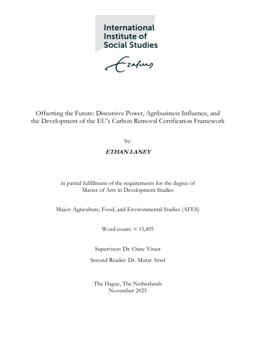
Offsetting the future: discursive power, agribusiness influence, and the development of the EU’s Carbon Removal Certification Framework
Publication
Publication
The study investigates the emergence of offsetting-based climate governance in European agriculture through an analysis of the European Commission’s Carbon Removal Certification Framework (CRCF). Despite its creation as tool for verifiable offsets, the CRCF functions as an venue for agribusinesses, corporate alliances, and technological intermediaries to advance market logics within EU climate policy. By analyzing policy documents, consultation records, stakeholder interviews, and critical scholarship, the study explores the rhetoric of technocratic authority, market environmentalism, and digital platformization embedded within the CRCF’s architecture. In doing so, it reveals how corporate influence is consolidated while financial and administrative burdens are displaced onto farmers. Ultimately, the study demonstrates that the CRCF and market-based mechanisms are unlikely to deliver equitable and verifiable climate benefits and instead deepen existing agricultural inequalities, delay deep emission reductions, and embed market environmentalism in Europe’s agricultural governance.
| Additional Metadata | |
|---|---|
| , , , , | |
| Visser, Oane | |
| hdl.handle.net/2105/76268 | |
| Agrarian, Food and Environmental Studies (AFES) | |
| Organisation | International Institute of Social Studies |
|
Laney, Ethan. (2025, December 18). Offsetting the future: discursive power, agribusiness influence, and the development of the EU’s Carbon Removal Certification Framework. Agrarian, Food and Environmental Studies (AFES). Retrieved from http://hdl.handle.net/2105/76268 |
|