2025-12-18
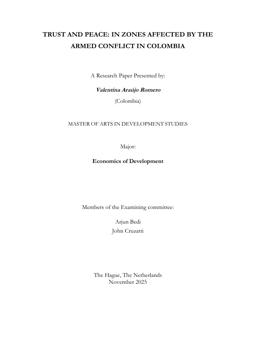
Trust and peace: in zones affected by the armed conflict in Colombia
Publication
Publication
This study explores how the implementation of Colombia’s Peace Agreement has shaped citizens’ trust between residents and institutions across conflict-affected territories. Drawing on panel data from over 12,000 individuals surveyed in the MAPS dataset (2019–2021), combined with information from the ART database on development projects, the analysis examines both perceived and actual implementation of peace-related actions through Fixed Effects (FE) and Ordinary Least Squares (OLS) models. Ultimately, the results reveal a paradox between expectation and observable outcomes, while perceived implementation shows a relationship with trust, the numbers of projects could not translate into improved trust perceptions. This suggests that trust is shaped less by the quantity of state actions than by how citizens interpret and experience them.
| Additional Metadata | |
|---|---|
| , , , , , | |
| Bedi, Arjun S. | |
| hdl.handle.net/2105/76272 | |
| Economics of Development (ECD) | |
| Organisation | International Institute of Social Studies |
|
Araujo Romero, Valentina. (2025, December 18). Trust and peace: in zones affected by the armed conflict in Colombia. Economics of Development (ECD). Retrieved from http://hdl.handle.net/2105/76272 |
|