2025-12-18
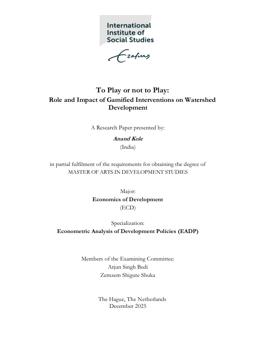
To play or not to play: role and impact of gamified interventions on watershed development
Publication
Publication
Watershed development programs continue to be riddled with the puzzle of participation and maintenance failures, despite showcasing positive agricultural, economic, and environmental benefits. Addressing that, the introduction of gamification as a policy design provides an alternate and complex avenue in the commons literature. The voluntary participation of the beneficiaries can provide an important policy design to the missing puzzle of participation, which the paper attempts to explore and provide insights into. The paper addresses this puzzle by understanding the motivation to participate in competition based on watershed development and the extent of its impact on groundwater level in the context of Paani Foundation’s Water Cup in Maharashtra, India. The paper utilizes a mixed method approach of qualitative interviews, participatory research tools, site visit and econometric evaluation of secondary data. The findings suggest that water scarcity is the major driver of participation and continuing participation, which is complemented by politico-administrative setup and local leadership, historical experiences of watershed activities, demonstration and bandwagon effects. The impact of the program participation is however muted for overall groundwater level increase. These results provide factors for motivation for voluntary participation in competition-based policy design and evidence for impact of gamified intervention.
| Additional Metadata | |
|---|---|
| , , , , , | |
| Bedi, Arjun S. | |
| hdl.handle.net/2105/76275 | |
| Economics of Development (ECD) | |
| Organisation | International Institute of Social Studies |
|
Kole, Anand. (2025, December 18). To play or not to play: role and impact of gamified interventions on watershed development. Economics of Development (ECD). Retrieved from http://hdl.handle.net/2105/76275 |
|