2025-12-18
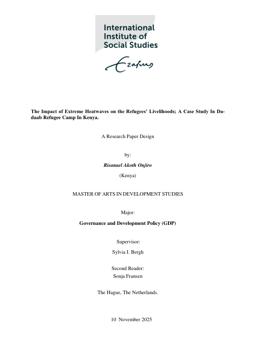
The impact of extreme heatwaves on the refugees’ livelihoods: a case study in Dadaab refugee camp in Kenya
Publication
Publication
As climate change intensifies, extreme weather events such as heatwaves are becoming more frequent and severe, creating uncertainty about the scale and scope of their impacts and disproportionately affecting vulnerable populations. This study examines the impact of heatwaves on the sustainable livelihoods of refugees, with a focus on their adaptive capacities. My research is inspired by the early research showing that refugee camps are vulnerable to climate change (Fransen et al., 2024). This study concluded that the refugees are exposed to heatwaves which greatly limit them from accessing sustainable livelihoods through directly affecting their quality of life and production time. Heat waves, combined with other factors, further hinder refugees’ ability to achieve sustainable livelihoods. Current heat-related policies often fail to address the complex realities of refugee experiences. Therefore, further research is needed to explore how policies can better incorporate community perspectives and focus on refugees’ specific needs, drawing lessons from successful local practices. Therefore, refugee voices also need to not only be incorporated at the policy design level but the community needs to lead the process to ensure their effectiveness and accountability to the refugee community. However, the study determined that this transformative process is not guaranteed. I apply the theoretical framework of sustainable livelihood and the concepts of vulnerability, adaptation to further understand the meanings and discourses surrounding sustainable livelihood. The Theory of Constrained Transformational Adaptation will be used to help understand the complexity of the relationship between policy and practice to answer the main research question; What are the impacts of heat-related policy implementation on refugees’ realities of sustainable livelihoods, and how are these impacts reflected in their everyday experiences and coping strategies? Therefore the aim of the study is to explore the absorptive, adaptive, and transformative capacity of institutional support, access and implementation to climate-responsive programs. To answer the research question, I used the qualitative method, drawing on field interviews, secondary data, and climate records from refugee settlements in Dadaab, Kenya.
| Additional Metadata | |
|---|---|
| , , , , , , , , | |
| Bergh, Sylvia I. | |
| hdl.handle.net/2105/76286 | |
| Governance and Development Policy (GDP) | |
| Organisation | International Institute of Social Studies |
|
Akoth Onjiro, Risanael. (2025, December 18). The impact of extreme heatwaves on the refugees’ livelihoods: a case study in Dadaab refugee camp in Kenya. Governance and Development Policy (GDP). Retrieved from http://hdl.handle.net/2105/76286 |
|