2025-12-18
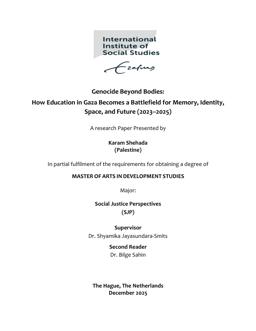
Genocide beyond bodies: How education in Gaza becomes a battlefield for memory, identity, space, and future (2023–2025)
Publication
Publication
Cultural genocide and cultural resilience go side by side, shaping the lived realities of Palestinians under Israeli systematic subjugation. In Gaza, the deliberate targeting of education, educational institutions, personnel and students as well as targeting Palestinian cultural practices seeks to erase Palestinians’ collective identity. Yet, the very same spaces (schools, remaining homes, mobile tents and community networks) become sites of resistance that preserve and transmit the Palestinian cultural knowledge and heritage. By examining this dual process of cultural genocide and cultural resilience, I will analyse how communities maintain their identity and continuity despite ongoing attempts at cultural erasure, making cultural resilience both tangible and deeply significant. This study aims to examine the systematic targeting of the education sector by the Israeli occupation in Palestine and how it constitutes a tool of cultural genocide. It also looks at how cultural resilience manifests in the face of this colonialism based on the logic of elimination. Although historically and across the globe, as well documented in several contexts such as China, Canada, Bosnia, and Rwanda, the use of the education system as an instrument of cultural genocide, there is a significant gap in the literature in studying Palestine in general and Gaza in particular regarding this crime. Most existing research focuses on physical destruction, trauma, and well-being, and the studies that extend to investigate genocide from culture, identity, and intellectual continuity perspectives are much less in terms of magnitude or depth. My Research draws on Raphael Lemkin's Cultural Genocide Theory (1947) alongside Settler-Colonial Theory (Patrick Wolfe, 2006), and Sumud (resilience) approach (Sazzad, 2015) in addition to Mbembe's concept of Necropolitics (2019), and Rob Nixon's theory of Slow Violence (2011). In this research, I argued that Palestine represents a par excellence example of Orientalism (Said, 1978). Palestinians are dehumanized, othered, and rendered unworthy through narratives that construct the Jews as intellectually and morally superior. This binary of “us” and “them” enables the justification of intense violence, including the denial of Palestinians’ very right to life. Thus, genocide becomes framed as both necessary and permissible within this civilizational logic of superiority. I used online semi-structured interviews with students, teachers, parents, and officials living in Gaza Strip (and some of them outside Gaza) as tools for data collection and analysis. The study also provides a critique of international responses that looks at cultural genocide as a side effect of the ongoing Israeli crimes. Drawing on 81 qualitative interviews I show how direct, slow, and structural violence converge in Gaza, through the bombing of schools, universities and archives, the suppression of identity, and the long-term siege. Yet, I look at how Palestinians transform education into an act of cultural resilience and “sumud.” Despite immense loss and disconnections, education continues to be a powerful tool of defiance, preserving collective memory and asserting the right to exist.
| Additional Metadata | |
|---|---|
| , , , , , , , | |
| Jayasundara-Smits, Shyamika | |
| hdl.handle.net/2105/76307 | |
| Social Justice Perspectives (SJP) | |
| Organisation | International Institute of Social Studies |
|
Shehada, Karam. (2025, December 18). Genocide beyond bodies: How education in Gaza becomes a battlefield for memory, identity, space, and future (2023–2025). Social Justice Perspectives (SJP). Retrieved from http://hdl.handle.net/2105/76307 |
|