2025-10-10
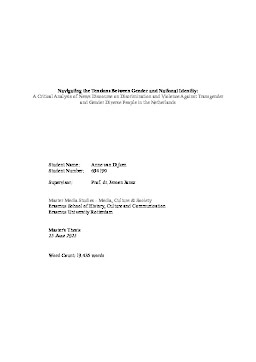
Navigating the Tensions Between Gender and National Identity
Publication
Publication
A Critical Analysis of News Discourse on Discrimination and Violence Against Transgender and Gender Diverse People in the Netherlands
Scholars have long acknowledged the powerful position of news media in society and its role as central channel through which people stay informed about the world, its structures, hierarchies, and phenomena. They have highlighted how this interconnectedness is evident through news media's meaning-making practices, which are closely connected to dominant ideologies, power inequalities, and general news routines and practices. This puts constraints on the representations of identities that challenge these hegemonic beliefs, such as transgender and gender diverse (TGD) people. In the Netherlands, TGD representation is shaped by the country's progressive and queer-friendly national self-image. However, recent years have seen a considerable increase in reports of gender-based discrimination and violence against TGD people. Therefore, this study explored the position and power of journalists in navigating these tensions in their news reporting on discrimination and violence against TGD people in the Netherlands. It centered around the research question: how are Dutch online news media representing discrimination and violence against transgender and gender diverse people in the Netherlands? Accordingly, a Critical Discourse Analysis was used to analyze Dutch news articles from both national and regional newspapers, as well as digital news websites. The analysis demonstrated how journalists constructed five different discourses that either focused on discrimination and violence against TGD people or the Netherlands and its national self-image. The first discourse positioned the issue as a problem and was constructed through a progressive ideological lens, an emphasis on fact-checking, and an activistic stance that advocated for change. The second discourse presented TGD people as a polarizing topic of discussion and was constructed through a (seemingly) neutral approach that gave voice to both progressive and conservative perspectives. The third discourse centered a political perspective and was characterized by discussions on legislations and the responsibility of the government in this issue. The fourth discourse focused on the Netherlands and represented its queer-friendly reputation as a myth by stressing current intolerant attitudes and the unsafe environment this creates. The final discourse positioned the Netherlands in a more positive light and focused on progress, positive developments, and comparisons with less tolerant countries. Overall, this study provided insights into how the sociocultural context of the Netherlands both shaped and is shaped by the construction of discourses around discrimination and violence against TGD people. In doing so, this study presented an updated outlook on social understandings of gender diverse identities, their position in Dutch society, and the role of journalists in challenging these power inequalities through more inclusive and authentic representations.
| Additional Metadata | |
|---|---|
| Jeroen Jansz | |
| hdl.handle.net/2105/76440 | |
| Media, Culture & Society | |
| Organisation | Erasmus School of History, Culture and Communication |
|
Anne van Dijken. (2025, October 10). Navigating the Tensions Between Gender and National Identity: A Critical Analysis of News Discourse on Discrimination and Violence Against Transgender and Gender Diverse People in the Netherlands. Media, Culture & Society. Retrieved from http://hdl.handle.net/2105/76440 |
|