2025-10-10
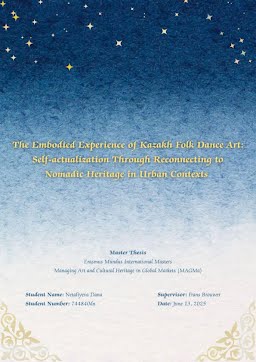
The embodied experience of Kazakh folk dance art: self-actualization through reconnecting to nomadic heritage in urban contexts
Publication
Publication
This master's thesis explores how the embodied practice of Kazakh folk dance fosters self-actualization by reconnecting individuals with their nomadic heritage in contemporary urban settings. At the core of the study lies a deep dive into the dance as a multilayered cultural practice, the value of which extends far beyond aesthetic appreciation. Each movement is seen as a vessel of intergenerational systems of thought and belief, capable not only of preserving tradition, but also of embodying and continuing it as a lived experience. The research is structured around three interrelated dimensions. First, focusing on the affective and cognitive levels of engagement, it positions dance as a form of self-expression that cultivates bodily awareness and emotional resilience. Second, it explores cultural rediscovery by demonstrating how Kazakh folk dance, rooted in a nomadic worldview and lifestyle, serves as a visual manifestation of spiritual ancestral heritage, one that is comprehended by practitioners through physical practice. Third, in seeking to understand the interpretive dimensions of the practice, the study looks at the importance of the choreographer's role in mediating tradition through storytelling and movement. Framed through the lens of living heritage, this thesis sees dance as a dynamic site for intersection of individual and collective, then and now, body and culture. It aligns with the Cultural Policy Concept of the Republic of Kazakhstan for 2023-2029, which highlights the relevance of various traditional forms of artistic expression, including folk dance, in strengthening national identity and cultivating creative capacity within society, thereby contributing to collective consciousness and well-being. Yet, despite its recognition as an important element of cultural heritage, the transformative social potential of Kazakh folk dance remains underexplored, particularly in relation to its practice as an amateur leisure activity. This study, therefore, seeks to bridge the gap by employing a human-centered approach. As a further point, qualitative fieldwork involves participant observation and semi-structured interviews with three groups of Kazakh dance practitioners: amateurs, professional choreographers, and academic researchers. Based on this material, the study identifies eight key pathways through which self-actualization through dance is, indeed, realized: (1) Identity and self-expression, (2) Immersive engagement and transformation of perception, (3) Spirituality, (4) Cultural awakening, (5) Kazakh dance as an embodied expression of ancestral knowledge, (6) Music and attire, (7) Choreographer as storyteller: dance as destiny and mission, (8) Dance as the heritage of the future. For participants of various ethnic backgrounds, dance becomes a space where personal experience, the desire to better understand oneself and one's roots, and a longing to belong, particularly within the hybrid identity shaped by Kazakhstan's multiethnic history, form a strong motivation to engage with the dance. In this process, the combination of symbolic depth and physical intensity becomes a tool for exploring questions that have not yet been verbalized. Several participants described a strong internal pull toward culture in all its forms, while professional practitioners and scholars emphasized their deeper mission to facilitate the process of initiating others into it. In this vein, it becomes evident that the nation is undergoing a process of cultural reimagination, as it moves away from inherited frameworks of imperial and Soviet thinking. Within this process, dance is instrumental, and spirituality, although interpreted differently by each individual, emerges as a central theme. In this context, the research revealed a broader understanding of spirituality, which was initially associated with harmony with nature. This harmony is not simply a return to nature as a separate realm, but rather an experience of integration with the world as it is lived day to day. In this sense, self-actualization occurs not only through connection with heritage, but through the creation of a dialogue with its many facets, which allows individuals to draw from it what resonates most with them. This underscores the importance of the human factor and subjective judgements. The study also revealed a deep sense of responsibility and a strong desire to preserve this artistic tradition for future generations, as well as to exercise agency in shaping its development while maintaining its core values and concepts. Although this question goes beyond the scope of the present research, it offers significant potential for future inquiry. As a result, the findings offer new insights for scholars, demonstrate the contemporary relevance of the topic, and lay the groundwork for more detailed future research on this embodied cultural practice.
| Additional Metadata | |
|---|---|
| Brouwer, Frans | |
| hdl.handle.net/2105/76443 | |
| Managing Art and Cultural Heritage in Global Markets | |
| Organisation | Erasmus School of History, Culture and Communication |
|
Dana Netaliyeva. (2025, October 10). The embodied experience of Kazakh folk dance art: self-actualization through reconnecting to nomadic heritage in urban contexts. Managing Art and Cultural Heritage in Global Markets. Retrieved from http://hdl.handle.net/2105/76443 |
|