2025-10-10
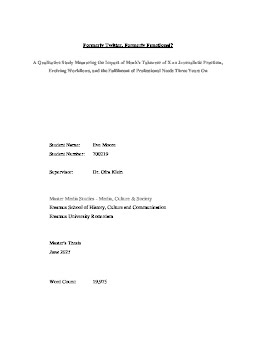
Formerly Twitter, Formerly Functional?
Publication
Publication
A Qualitative Study on the Impact of Musk's Takeover of X on Journalistic Practices, Evolving Workflows, and the Fulfilment of Professional Needs Three Years On
This thesis explores how Elon Musk's 2022 takeover of X (formerly Twitter) has affected the working practices of journalists, taking the Irish media context as a case study. Over the past decade, X has played a fundamental role in journalism, serving as a key space and resource for newsgathering, information dissemination, professional visibility, and audience engagement. However, since Musk's acquisition in 2022 and subsequent governance changes, many journalists have reported a deterioration in the platform's functionality, safety, and credibility. This research examines how these changes shaped journalists' responses, adaptations, and perceptions of their professional needs related to their use of X. The central research question guiding this study is: How has the takeover of X affected the work of journalists? It also explores the key factors influencing these responses, including personal circumstances, professional constraints, and platform dependency. A second question examines: What factors and motives, including journalists' individual needs and circumstances, shape and interact with their responses to these changes in working practices? The study's findings are derived from a thematic analysis of semi-structured interviews with nine Irish journalists representing a variety of organisations, roles and career stages. Findings show that while all journalists acknowledged X's previous centrality to their work, the platform's takeover has reduced its professional utility and prompted varied responses, including full disengagement and continued use with significant adaptations. Some journalists noted benefits to staying on X, particularly for real-time access and network visibility, while others cited increased abuse, reduced trust in information credibility, and dissatisfaction with platform governance. Emerging themes include shifts in platform affordances, ethical and practical dilemmas around staying or leaving, differentiated impacts and adaptation strategies. Journalist's responses were shaped not only by personal preferences but also by professional needs. For example, younger journalists and those with high visibility or sourcing demands found disengaging with X harder, while established or freelance journalists with strong offline networks had more flexibility. Career stage, journalistic specialisation and role, gender, and political views were also predictors of these choices. Overall, this study illustrates how journalists navigate changes in platform governance and affordances through strategies such as platform migration and swinging, disengagement, symbolic resistance, or behavioural adaptations while remaining on the platform, all of which are shaped by several key factors. Moreover, this research adds to growing literature by showing how ever-evolving platform governance changes expose journalists to risks like abuse and disinformation, reshaping professional practices in a volatile, platform-centric media environment.
| Additional Metadata | |
|---|---|
| Ofra Klein | |
| hdl.handle.net/2105/76469 | |
| Media, Culture & Society | |
| Organisation | Erasmus School of History, Culture and Communication |
|
Eve Moore. (2025, October 10). Formerly Twitter, Formerly Functional?: A Qualitative Study on the Impact of Musk's Takeover of X on Journalistic Practices, Evolving Workflows, and the Fulfilment of Professional Needs Three Years On. Media, Culture & Society. Retrieved from http://hdl.handle.net/2105/76469 |
|