2025-10-10
Direct or Indirect
Publication
Publication
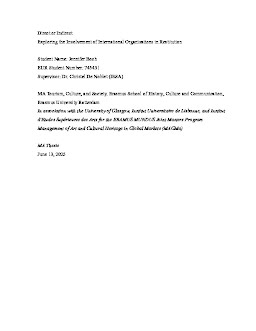
Exploring the Involvement of International Organizations in Restitution
Restitution has increasingly become an important discussion within the public sphere. It can be a diplomatic tool that helps reshape international relationships, a catalyst to community healing and cultural regeneration, or a simple matter of abiding by the law. Within the field of cultural heritage studies there is the idea that a moral shift has taken place, with much of this stemming from the work done by international organizations. This research focuses on the significant role of international organizations in restitution processes and attempts to understand to what extent does the involvement of an international organizations impact restitution? This is done through a qualitative comparative case study analysis, using content analysis and process tracing to answer the two key sub-questions: 1) how are international organizations involved; 2) and how does their involvement impact restitution cases. Two international organizations have been selected to represent two different levels of involvement, direct and indirect, with two examples provided for each case. UNESCO is an international organization that is directly involved with restitution through its role in establishing relevant international law, as well as creating a committee specifically devoted to such matters, the ICPRCP. This case is examined through the restitution of Cambodia's Koh Ker Statues and in the dispute between Turkey and Germany regarding the Bo?azköy Sphinx. ICOM is an international organization which is more indirectly involved as it promotes standards for parties involved in restitution and provides important tools, such as the Red Lists. This case is examined through two broader examples, the restitution movements for Nepal and Afghanistan. Through this analysis, we understand that both direct and indirect involvement can be very useful in restitution process, especially when the main parties involved are states. However, international organizations could probably do more impactful work. These organizations and their top-down approach may be outdated as there are many new key actors involved. Some of the impact of their involvement may be limited by this limitation in scope, as well as a hesitance to take a firm side on certain contexts of restitution, such as objects with a colonial or imperial related provenance. In the end, we must reaffirm that restitution is a highly complex and multifaceted topic with every example unique. This research wishes to serve as a foundation for future analysis into the questions, as the few examples used are not enough to make concrete claims.
| Additional Metadata | |
|---|---|
| Noblet, Christel de | |
| hdl.handle.net/2105/76488 | |
| Managing Art and Cultural Heritage in Global Markets | |
| Organisation | Erasmus School of History, Culture and Communication |
|
Jennifer Boch. (2025, October 10). Direct or Indirect: Exploring the Involvement of International Organizations in Restitution. Managing Art and Cultural Heritage in Global Markets. Retrieved from http://hdl.handle.net/2105/76488 |
|