2025-10-10
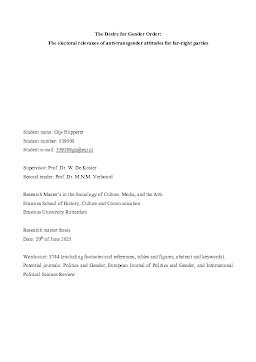
The Desire for Gender Order
Publication
Publication
The electoral relevance of anti-transgender attitudes for far-right parties
In the Western world, the far-right is increasingly opposed to transgender identities, which is remarkable as opposition in prior decades came primarily from Christian parties. The position of the far-right begs the question of whether their supply of anti-transgender opposition reflects a demand by an electorate holding anti-transgender attitudes. Building on prior literature on the dimensions of cultural conflict, this study posits two theories to understand anti-transgender attitudes among the electorate. The dominant theory suggests that anti-transgender attitudes have a social basis in religious orthodoxy and is prevalent among those with traditionalist attitudes. Alternatively, this study - inspired by the reification theory - proposes that the far-right electorate also holds anti- transgender attitudes, which has a social basis in an aversion to diversity and is prevalent among those with authoritarian attitudes. Analysing data from the Dutch Parliamentary Election Study of 2023 (DPES), this study tests these two theories about the place of anti-transgender attitudes within the dimensions of cultural conflict and assesses its electoral relevance in the Netherlands. The findings indicate that both theories are necessary to explain anti-transgender attitudes in the Netherlands. First, authoritarianism as well as traditionalism relates to anti-transgender attitudes, which indicates that it is not evidently an issue of the traditionalist dimension, and substantiates the relevance of both theories. Second, those with more traditionalist attitudes vote for Christian parties, while those with more authoritarian attitudes vote for the far-right, which aligns with the dominant theory. Third, those who hold anti-transgender attitudes are more likely to vote for either Christian parties or the far-right, which also substantiates the relevance of both theories. These findings - consistent with the reification theory - show the existence of a (non-religious) authoritarian electorate that holds anti-transgender attitudes for distinctly different reasons than the traditionalist electorate. This implies that - contrary to some secularisation theories - a post-Christian morality does not equate a morally progressive worldview.
| Additional Metadata | |
|---|---|
| De Koster, Willem | |
| hdl.handle.net/2105/76504 | |
| Sociology of Culture, Media and the Arts | |
| Organisation | Erasmus School of History, Culture and Communication |
|
Huppertz, Gijs. (2025, October 10). The Desire for Gender Order: The electoral relevance of anti-transgender attitudes for far-right parties. Sociology of Culture, Media and the Arts. Retrieved from http://hdl.handle.net/2105/76504 |
|