2025-10-10
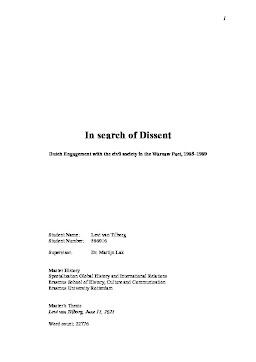
In search of Dissent
Publication
Publication
Dutch Engagement with the civil society in the Warsaw Pact, 1985-1989
This thesis explores how Dutch embassies, and their diplomatic staff engaged with the civil societies of the non-Soviet Warsaw Pact member states between 1985 and 1989, a period marked by political upheaval and the eventual collapse of communist regimes across Eastern Europe. While the revolutions of 1989 have been widely studied, the specific role of Dutch diplomacy in responding to the rise of civil society in the Eastern Bloc has remained underexplored. This study seeks to fill that gap by examining the perspective of Dutch diplomats based in embassies, looking at archival sources to understand the nature, scope, and limitations of engagement with emerging opposition movements during the final years of the Cold War. The main research question guiding this thesis is: How did Dutch embassy personnel engage diplomatically with non-Soviet Warsaw Pact member states and their civil societies between 1985 and 1989? Using Bent Boel's conceptual model of layered diplomatic engagement, ranging from recognition without outreach to direct contact, the thesis provides an analysis across six countries: East Germany, Poland, Czechoslovakia, Hungary, Romania, and Bulgaria. Methodologically, the study employs qualitative hermeneutic analysis of diplomatic correspondence, internal memos, and reports drawn from the Dutch National Archives. These are examined alongside secondary literature on civil society, Cold War diplomacy, and Dutch foreign policy. Findings reveal that Dutch diplomats were often cautious and reactive, particularly in the early stages of the period studied, despite a reputation of fighting for human rights violations in the Warsaw Pact. In most cases, engagement remained limited to indirect or symbolic forms of support, especially outside Poland. However, as civil society became a political force to be reckoned with in the late 1980s, Dutch diplomats increasingly sought out opposition movements, especially in countries where political reforms began to be implemented. Still, they largely underestimated the momentum building within civil societies and were caught off guard by the speed and scale of the revolutions of 1989.
| Additional Metadata | |
|---|---|
| Lak, Martijn | |
| hdl.handle.net/2105/76514 | |
| Global History and International Relations | |
| Organisation | Erasmus School of History, Culture and Communication |
|
Tilborg, Levi van. (2025, October 10). In search of Dissent: Dutch Engagement with the civil society in the Warsaw Pact, 1985-1989. Global History and International Relations. Retrieved from http://hdl.handle.net/2105/76514 |
|