2025-10-10
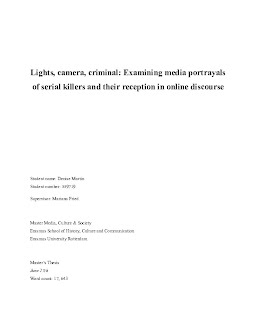
Lights, camera, criminal: Examining media portrayals of serial killers and their reception in online discourse
Publication
Publication
True crime has become a dominant genre in contemporary media culture, raising complex ethical questions about representation, sensationalism, and public fascination with violence. This thesis examines how serial killers are portrayed in various media formats and how audiences respond to these portrayals when reviewing them online. Using Jeffrey Dahmer as a case study, the study analyzes the dramatized series Monster: The Jeffrey Dahmer Story and the documentary Conversations with a Killer: The Jeffrey Dahmer Tapes, as well as audience reviews gathered from Rotten Tomatoes. The study is based on Stuart Hall's encoding/decoding model and framing theory, which together help in understanding how media texts are constructed and how audiences actively negotiate meaning. The study uses qualitative content analysis to investigate how each media format constructs character, frames moral responsibility, and engages with cultural narratives about crime and justice. With an examination of 223 Rotten Tomatoes audience reviews, the study also explores how audiences interpret and respond to these portrayals, focusing on the emotional, ethical, and ideological dimensions of viewer reactions. Findings reveal five major themes regarding the representation of Dahmer: 1) The many faces of Dahmer, 2) Dahmer as a product of social institutions, 3) The idea of the "monster," 4) The aesthetic monster, and 5) Dahmer through the eyes of others. Findings also reveal that while the two formats differ stylistically-utilizing distinct narrative techniques, emotional tones, and aesthetic strategies-they frequently construct similar characterizations of Dahmer. This suggests that true crime media may be influenced by underlying cultural frameworks that transcend genres. Audience responses ranged from empathy to ethical critique, confirming Hall's encoding/decoding model and demonstrating that viewers actively engage in negotiating the meanings presented to them. The study adds to media and cultural studies by emphasizing the increasingly participatory role of audiences, the narrative constraints of true crime storytelling, and the ethical tensions that arise when real-life violence is mediated for the public. It advocates for a greater emphasis on both media form and audience agency in understanding how crime narratives are constructed, received, and contested in the digital era.
| Additional Metadata | |
|---|---|
| Mariana Fried | |
| hdl.handle.net/2105/76527 | |
| Media, Culture & Society | |
| Organisation | Erasmus School of History, Culture and Communication |
|
Denise Martin Weijters. (2025, October 10). Lights, camera, criminal: Examining media portrayals of serial killers and their reception in online discourse. Media, Culture & Society. Retrieved from http://hdl.handle.net/2105/76527 |
|