2025-10-10
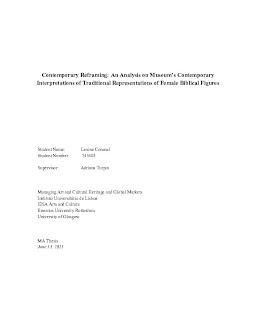
Contemporary Reframing: An Analysis on Museum's Contemporary Interpretations of Traditional Representations of Female Biblical Figures
Publication
Publication
This study seeks to analyze the contemporary reinterpretations of museums towards handling collections of female biblical figures who have often been intertwined in complex histories and intricately layered discourses. Where some of these depictions have been rooted in androcentrism resulting in sexualized depictions and portraying these figures in manifestations that appeal to male audiences. This poses a problem with normalizing objectification amongst women where this was merely seen as a standard artistic convention which has historically been accepted and rarely questioned. This approach disguises the perpetuation of gender biases which is no longer acceptable within the context of contemporary social issues where society has become increasingly aware, demanding for higher accountability in the messages that are put forward. The portrayals of Susanna and her assailants have been a popular depiction for centuries, painting scenes of her sexual assault in bright vivid colors. The contextualization of Susanna in contemporary museums today is the definitive factor of whether her image will continue to contribute to justifying voyeurism in plain sight or where museums can use this image to send a powerful message instead - challenging and vindicating the narratives of violating a woman's body. Similarly, Mary Magdalene's iconography in art has been heavily shaped and tainted by an allegation, diminishing her sanctity and womanhood - through recent calls to action regarding recontextualizing her identity, institutions have revisited and revised their curatorial narratives depicting her. Varying depictions of female biblical figures stand out which historically have been less sexualized but are popularly depicted for its gore and violence such as the image of Judith. Her story has been used as a symbol of strength but also instills fear over female agency. Contemporary museums have used her powerful imagery linking this together with story of Artemisia Gentileschi, a survivor of rape who had released her frustrations of injustice and gender inbalance on to her craft. This link has uplifted both women to symbols of power and resilience amidst patriarchal domination, heavily resonating with ongoing societal issues. Lastly, the depiction of Esther as a queen dressed in beautiful garments is given greater meaning in shedding light to the reason behind her frequent portrayals during the liberation of the Netherlands from Spain in the 17th century. Transforming her image from a static decorative artwork, to a powerful symbol of freedom. Through analyzing these reinterpretations of contemporary museums, we hold institutions to a higher degree, as a space that both cultivates and reflects cultural practices using collective memory in shaping the future, allowing for a more inclusive and conscious society.
| Additional Metadata | |
|---|---|
| Turpin, Adriana | |
| hdl.handle.net/2105/76725 | |
| Managing Art and Cultural Heritage in Global Markets | |
| Organisation | Erasmus School of History, Culture and Communication |
|
Lexine Coronel Ponce. (2025, October 10). Contemporary Reframing: An Analysis on Museum's Contemporary Interpretations of Traditional Representations of Female Biblical Figures. Managing Art and Cultural Heritage in Global Markets. Retrieved from http://hdl.handle.net/2105/76725 |
|