2025-12-19
Digital governance and hyper-local, grass-roots response in the crisis governance of the 2025 Eaton Fire
Publication
Publication
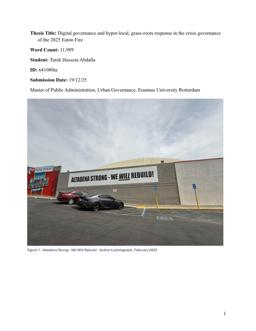
This thesis examines the role of hyperlocal digitally mediated grassroots actors in unincorporated communities in crisis governance contexts, utilizing the January 2025 Eaton Canyon Fire in Altadena, California, as a case study. Due to Altadena, California's fragmented, unincorporated status, residents turned to digitally mediated, hyperlocal grassroots groups to coordinate warnings, share information, and organize recovery efforts. Drawing on a dual typology—structural (Emergent Groups, Community-Based Initiatives, Boundary-Spanning Initiatives) and functional (sensor, trusted node, agent)—the study analyzes how citizen roles evolved across the crisis timeline: preparedness, response, and recovery (Houston et al., 2015). Using a qualitative research methodology, this study assessed how hyperlocal digitally mediated grassroots actors contribute to crisis governance in an unincorporated, hyperlocal community, using a case study design. The findings reveal that informal digital actors not only filled coordination gaps left by formal agencies but also engaged in emotional support, symbolic recovery, and cross-platform translation. This study contributes to the literature on crisis governance, digitally embedded hyperlocal, grassroots actors, and crisis informatics by showing how platform-based actors in structurally ambiguous jurisdictions become essential to adaptive emergency management. It indicates that citizen-led initiatives, through their temporal fluidity and digital credibility, form the backbone of informal governance in high-risk, under-governed contexts. The thesis concludes with recommendations for integrating grassroots platforms into formal emergency planning frameworks.
| Additional Metadata | |
|---|---|
| Pagliarin, S., Van Meerkerk, I.F. | |
| hdl.handle.net/2105/78040 | |
| Public Administration | |
| Organisation | Erasmus School of Social and Behavioural Sciences |
|
Abdalla, T.H.H. (2025). Digital governance and hyper-local, grass-roots response in the crisis governance of the 2025 Eaton Fire. In Public Administration.http://hdl.handle.net/2105/78040 |
|