2025-08-09
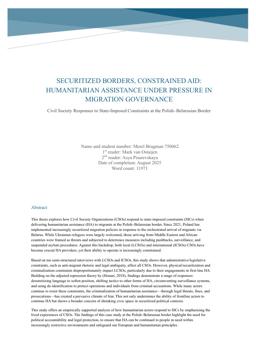
SECURITIZED BORDERS, CONSTRAINED AID: HUMANITARIAN ASSISTANCE UNDER PRESSURE IN MIGRATION GOVERNANCE
Publication
Publication
This thesis explores how Civil Society Organizations (CSOs) respond to state-imposed constraints (SICs) when delivering humanitarian assistance (HA) to migrants at the Polish–Belarusian border. Since 2021, Poland has implemented increasingly securitized migration policies in response to the orchestrated arrival of migrants via Belarus. While Ukrainian refugees were largely welcomed, those arriving from Middle Eastern and African countries were framed as threats and subjected to deterrence measures including pushbacks, surveillance, and suspended asylum procedures. Against this backdrop, both local (LCSOs) and international (ICSOs) CSOs have become crucial HA providers, yet their ability to operate is increasingly constrained.<br /> <br /> Based on ten semi-structured interviews with LCSOs and ICSOs, this study shows that administrative/legislative constraints, such as anti-migrant rhetoric and legal ambiguity, affect all CSOs. However, physical/securitization and criminalization constraints disproportionately impact LCSOs, particularly due to their engagements in first-line HA. Building on the adjusted repression theory by (Honari, 2018), findings demonstrate a range of responses: desensitizing language to soften position, shifting tactics to other forms of HA, circumventing surveillance systems, and using de-identification to protect operations and individuals from criminal accusations. While many actors continue to resist these constraints, the criminalization of humanitarian assistance—through legal threats, fines, and prosecutions—has created a pervasive climate of fear. This not only undermines the ability of frontline actors to continue HA but shows a broader concern of shrinking civic space in securitized political contexts. <br /> This study offers an empirically supported analysis of how humanitarian actors respond to SICs by emphasizing the lived experiences of CSOs. The findings of this case study at the Polish–Belarusian border highlight the need for political accountability and legal protection, to ensure that HA can be continued to people in need within increasingly restrictive environments and safeguard our European and humanitarian principles. <br />
| Additional Metadata | |
|---|---|
| , , , , | |
| Van Ostaijen, M.M.A.C., Pisarevskaya, A. | |
| hdl.handle.net/2105/78106 | |
| Governance of Migration and Diversity | |
| Organisation | Erasmus School of Social and Behavioural Sciences |
|
Brugman, M.M. (2025). SECURITIZED BORDERS, CONSTRAINED AID: HUMANITARIAN ASSISTANCE UNDER PRESSURE IN MIGRATION GOVERNANCE. In Governance of Migration and Diversity.http://hdl.handle.net/2105/78106 |
|