2025-07-01
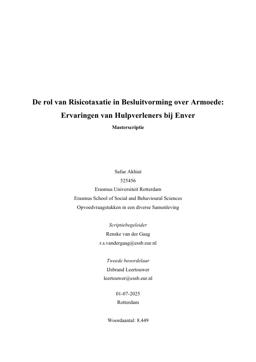
De rol van Risicotaxatie in Besluitvorming over Armoede: Ervaringen van Hulpverleners bij Enver
Publication
Publication
Samenvatting Dit kwalitatieve onderzoek richt zich op hoe hulpverleners van jeugdhulporganisatie Enver de besluitvorming rondom armoede ervaren en welke rol het Actuarieel Risicotaxatie-Instrument voor Jeugdbescherming (ARIJ) daarin speelt. Er zijn semigestructureerde interviews afgenomen met acht hulpverleners uit vier verschillende werkvormen (residentiele zorg, pleegzorg, Enver op School en crisishulp) van Enver in Rotterdam. De analyse van data is uitgevoerd met behulp van thematische analyse, waarin zowel deductieve als inductieve codering is toegepast. Het Decision-Making Ecology Model dient als theoretisch kader voor het onderscheiden van vier beïnvloedende factoren van besluitvorming: casus factoren, hulpverlener factoren, organisatorische factoren en externe factoren. De resultaten laten zien dat armoede zelden als een op zichzelf staand risico wordt gezien, maar in samenhang met andere factoren wordt gewogen. De ARIJ wordt daarin voornamelijk gebruikt ter structurering of verantwoording van bestaand professioneel oordeel. Hulpverleners ervaren belemmeringen in het bespreken en scoren van armoede, onder andere door schaamte bij ouders, gebrek aan training en onduidelijk beleid. Ook eerdere ervaringen met gezinnen en de beschikbaarheid van externe hulpinzetting beïnvloeden besluitvorming. Concluderend laat dit onderzoek zien dat risicotaxatie slechts effectief is wanneer structurele, organisatorische en relationele factoren samenkomen. Aanbevolen wordt om hulpverleners gericht te trainen in gespreksvoering over armoede en het invullen van de ARIJ. Ook wordt aangemoedigd om de ARIJ beter te integreren in werkprocessen en aandacht voor financiële stress te versterken in beleid en praktijk. Abstract This study investigates how youth care professionals at the organization Enver in Rotterdam perceive decision-making around poverty and how the Actuarial Risk assessment Instrument for Youth Protection (ARIJ) supports that process. Semi-structured interviews were conducted with eight professionals from four different service domains (residential care, foster care, school-based support, and crisis intervention). Data were collected through semi-structured interviews. Thematic analysis was used to analyze the data, combining both deductive and inductive coding. The Decision-Making Ecology Model served as the theoretical framework to distinguish four levels of influence: case-related factors, practitioner-related factors, organizational-related factors, and external factors. The findings show that poverty is rarely identified as an independent risk factor, but rather as intertwined with broader family issues. The ARIJ is used inconsistently and primarily serves as a tool for structuring or justifying existing professional judgements. Professionals report challenges in addressing and scoring poverty, due to parental shame, lack of training, and ambiguous policy implementation. Previous experiences with families and the availability of external support also influence decision-making. In conclusion, this study demonstrates that risk assessment is only effective when structural, organizational, and relational conditions are aligned. It is recommended that professionals receive training in discussing poverty, and the use of the ARIJ. It is also important that the ARIJ becomes more clearly integrated in both policy and frontline work.
| Additional Metadata | |
|---|---|
| Van der Gaag, R.S., Leertouwer, I. | |
| hdl.handle.net/2105/78121 | |
| Pedagogical Sciences | |
| Organisation | Erasmus School of Social and Behavioural Sciences |
|
Akhiat, S. (2025). De rol van Risicotaxatie in Besluitvorming over Armoede: Ervaringen van Hulpverleners bij Enver. In Pedagogical Sciences.http://hdl.handle.net/2105/78121 |
|