2025-10-10
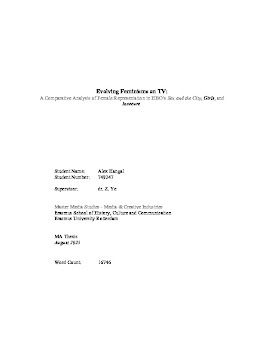
Evolving Feminisms on TV
Publication
Publication
A Comparative Analysis of Female Representation in HBO's Sex and the City, Girls, and Insecure
The demands for feminist representation have shifted from requests for visibility to more nuanced expectations regarding authenticity, inclusivity, and intersectionality. Viewers are no longer content with superficial representations of strong women; there is growing demand on media to depict real-life experiences influenced by race, class, sexuality, and cultural background. Representation is now anticipated to confront structural inequality instead of avoiding it with individualistic stories. With feminist discourse gaining greater visibility, audiences are increasingly scrutinizing which narratives are presented, who narrates them, and how power flows through media channels that assert progressive ideologies. In this thesis, I address how feminist discourse is depicted and mediated in HBO's Sex and the City, Girls, and Insecure. All three of these series, which debuted in separate decades, present us with their own takes on womanhood, empowerment and identity. I was also curious about the way each series responds to the political and cultural demands of its day, and in what those changing approaches said about the larger shifting demands for feminist representation on TV. My central research question is: How do HBO's Sex and the City, Girls, and Insecure reflect the evolving demands for diverse representation in feminism? I approach this by combining thematic analysis with critical discourse analysis. I analyze four episodes per series, selected for their narrative weight and relevance to feminist themes. This includes the pilots and finales, as well as episodes that sparked discussion or explicitly addressed gender, race, or empowerment. I use feminist media theory to guide my reading, drawing on work by scholars such as Gill, Banet-Weiser, Rottenberg, Crenshaw, and hooks. Throughout my analysis, I found that Sex and the City presents empowerment largely through consumption, confidence, and emotional control. It promotes a version of postfeminist freedom that is appealing but narrow, where choice is central but structural critique is absent. Girls shifts the tone by making visible the discomfort, contradiction, and privilege that underlie this model. Its feminism is messier and more ambivalent, though often still centered around white middle-class subjectivity. Insecure moves further by centering Black womanhood, showing how race, community, and emotional labor shape the meaning of confidence and success.
| Additional Metadata | |
|---|---|
| Zhen Ye | |
| hdl.handle.net/2105/76424 | |
| Media & Creative Industries | |
| Organisation | Erasmus School of History, Culture and Communication |
|
Alex Hangal. (2025, October 10). Evolving Feminisms on TV: A Comparative Analysis of Female Representation in HBO's Sex and the City, Girls, and Insecure. Media & Creative Industries. Retrieved from http://hdl.handle.net/2105/76424 |
|