2025-10-10
The Power of Domesticity
Publication
Publication
A Historical Analysis of Dutch Newspaper Imagery in Conflict Reporting (1922-1994)
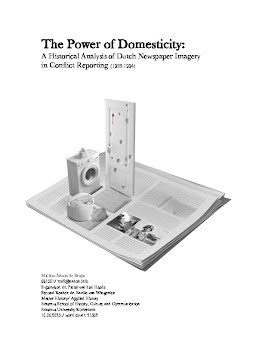
This paper examines the evolution of visual representations of conflict in Dutch newspaper media throughout the twentieth century. Drawing on visual imaginaries by analysing changes in photographic practices, such as framing, subject positioning, signifying elements, and the use of space, this research reveals how visual patterns contribute to shaping shared cultural understandings of conflict and how these have changed over time. Employing a combination of multimodal artificial intelligence and semiotic analysis, the study conducts a quantitative visual examination of the "Koninklijke Bibliotheek Kranten - 1 Miljoen" dataset, which includes 1.6 million digitised images and captions from Dutch newspapers published between 1922 and 1994. This approach enables a longitudinal perspective on Dutch conflict reporting and its evolving visual language. The inspiration for this thesis was provoked by observations surrounding current conflict reporting, which often uses domestic fragments and environments to narrate. These archetypical domestic elements, representing Russian-Ukrainian and Israeli-Palestinian wars, are widely recognisable across Western societies. As such, they foster empathy by mirroring the viewer's own most private spaces, offering an emotional bridge between distant conflict and everyday life without directly documenting human suffering. These findings sparked a wonder about how such conventions have developed historically and how changing cultural, political, and technological contexts have shaped the visual imaginaries of conflicts published in Dutch newspaper media.
| Additional Metadata | |
|---|---|
| Heede, Pieter van den | |
| hdl.handle.net/2105/76515 | |
| Applied History | |
| Organisation | Erasmus School of History, Culture and Communication |
|
Bruijn, Michou de. (2025, October 10). The Power of Domesticity: A Historical Analysis of Dutch Newspaper Imagery in Conflict Reporting (1922-1994). Applied History. Retrieved from http://hdl.handle.net/2105/76515 |
|